

You finish a UWorld block and face the familiar question: what do you actually do with all of the incorrects? Redo them? Turn them into Anki cards? Copy notes into a spreadsheet? Save screenshots and hope you come back later?
The best way to review UWorld incorrects for the MCAT is not one universal method. An incorrect answer can reveal a missing fact, weak application, a misread stem, a reasoning error, or a timing habit. Each problem needs a different next step. Treating every miss the same way creates either an oversized deck, an unused error log, or a reset full of questions you recognize without truly understanding.
Here is the short answer: redo questions when the issue is application, make a recall card when the issue is memory, and log or tag the miss when the issue is a repeated pattern. Your job after each important UWorld question is to identify the cause, write one transferable rule, and send it to the right kind of review.
The 3-way UWorld incorrects decision
Use this table before deciding what to do with a wrong, guessed-right, slow-right, or uncertain-right question.
| What caused the miss? | Best next step | Why |
|---|---|---|
| You understood the concept but could not apply it in the passage or calculation | Redo later or test the rule on fresh practice | You need to practice the decision, not memorize an old answer choice |
| You could not retrieve a fact, equation, relationship, or mechanism | Make one concise recall card | A short prompt lets you test whether the knowledge becomes stable over time |
| You misread the stem, made a logic leap, rushed, or chose without passage evidence | Log the error type and create a targeted process repair | More facts do not reliably fix a reading, reasoning, or pacing habit |
This is why a question can produce more than one task. A Biology/Biochemistry question may expose an unstable enzyme relationship and a habit of choosing before checking the data. The relationship belongs in a recall prompt. The premature decision belongs in an error log with a rule such as, “State the observed result before naming the mechanism.”
The AAMC advises reviewing incorrect and flagged questions after practice and identifying why the miss happened and how you will address it. AAMC’s MCAT study-plan guidance supports a review loop that leads to a specific repair, not just an explanation you read once.
When should you redo a UWorld incorrect?
Redoing can be useful when you want to check whether you can make the right decision after the original explanation is no longer fresh. It is most useful when the question tested an application step: interpreting a graph, linking a calculation to the target variable, using a passage condition, or eliminating choices with a clear rule.
Give yourself enough delay that you must reason again. If you can remember the visual layout of the passage or the correct letter, a repeat attempt may only measure recognition. Before redoing, cover the old result and ask yourself what rule or evidence you would need on a similar question.
Redo an incorrect when it can test application
For example, you miss a physics question because you calculated a value but did not check whether the question asked for resistance, current, or voltage. The repair is not a card with the original numbers. Write the rule, “Name the requested variable and check units before calculating,” then redo a comparable calculation after a delay or use a new timed question to test it.
Do not automatically reset every UWorld incorrect. If the old item feels familiar but the rule does not transfer, fresh practice is usually a more honest test. UWorld’s support materials describe using marked or incorrect-question modes to revisit selected questions, which makes targeted repeats more practical than an all-or-nothing reset. UWorld question-review guidance
When should a UWorld incorrect become an Anki card?
Make a card when you can turn the lesson into a small, answerable prompt. Strong card material includes:
- A definition, equation relationship, pathway step, or mechanism you could not retrieve.
- A comparison that keeps causing confusion.
- A fact that became obvious after reading the explanation but was unavailable during the block.
- A compact rule you need to recall before you can apply it in a passage.
For instance, if you cannot state how competitive inhibition changes apparent Km and Vmax, a card can test that relationship directly. Avoid copying the full question, passage, or rationale into the card. That creates a long note that is easier to recognize than retrieve.
Anki is especially useful for returning to facts and rules after they have faded. A systematic review in health-professions education found benefits for retrieval practice and/or distributed practice in 43 of 63 included experiments, while also noting that the interventions varied. Retrieval and distributed-practice systematic review
For more detail on separating recall cards from process errors, see Anki vs. an MCAT mistake journal.

When is an error log more useful than another card?
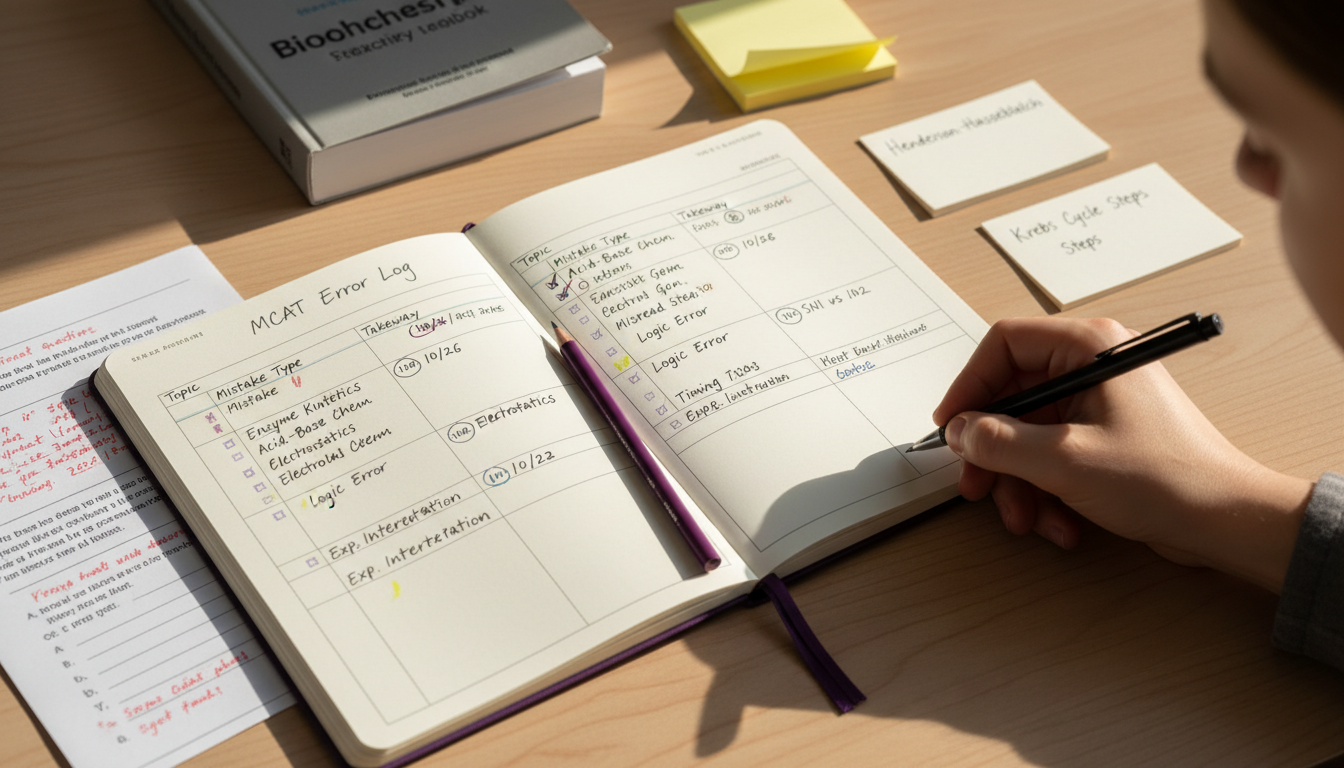
An error log is useful when the miss tells you something about how you take questions, not simply what you know. A card will not reliably repair a missed negative qualifier, a rushed calculation, an unsupported inference, or a CARS answer chosen from outside knowledge.
Use a short entry for any miss that reveals a repeatable behavior. Keep the original question and full explanation in UWorld or another permitted source. Your personal record only needs the context required to recognize the pattern later.
The five tags to use for UWorld incorrects
| Tag | What it means | First repair |
|---|---|---|
| Content gap | The fact, concept, relationship, or pathway was missing | Focused concept review and a recall prompt |
| Misread stem | You missed a qualifier, unit, task word, or condition | A visible final-line and qualifier checkpoint |
| Logic flaw | You knew the facts but made an unsupported inference | A take-home rule plus a fresh reasoning drill |
| Timing or rushing | You got stuck, cut a step, or rushed late in the block | A pacing behavior and a timed retest |
| Uncertain or guessed | You landed on the right answer without stable reasoning | Capture the missing rule or evidence habit before it becomes a future miss |
LoopdMed’s Error Taxonomy keeps those causes distinct, so “study more” does not become the default response to every incorrect. A question can have several issues, but choose the earliest meaningful cause as the primary tag. That makes the next action clearer.
Why screenshots and notes alone break down
Screenshots are fast. Notes can help you remember what felt confusing. Neither automatically creates a review loop. A camera-roll folder cannot show whether five saved questions were all timing errors, whether you fixed the same mistake last week, or which rule should come back before your next block.
If a screenshot is worth saving, take one more minute to record the error type, one take-home rule, and one next action. That is enough to turn a captured explanation into a task you can revisit. A short record is more likely to survive a difficult review day than a detailed page you never reopen.
LoopdMed’s Missed Question Log is designed to keep the source, error reason, rule, and follow-up review together without recreating licensed QBank material.
A 15-minute post-block workflow for UWorld incorrects
Use this after a practice block. It is a template, not a rigid time limit; a difficult concept or passage may need a longer review. The aim is to prevent a routine backlog, not rush through an important miss.
- Flag priority questions. Start with wrong, guessed-right, slow-right, and uncertain-right items. Let secure correct answers go unless they expose a useful weakness. This guide explains how to prioritize MCAT correct answers.
- Re-answer before reading the rationale. Briefly try to identify the missing rule, evidence, or condition while the question is still available.
- Choose one primary cause. Tag content gap, misread stem, logic flaw, timing, or uncertainty.
- Write one transferable rule. Replace “review electrochemistry” with a statement you can use on a new item.
- Route the lesson. Redo later for application, make a card for recall, or set a checkpoint or drill for a process problem.
- Schedule or retest it. Use a focused review queue and fresh practice to see whether the same mistake returns.
This structure keeps review specific enough to matter and light enough to repeat after every block. For the complete question-review framework, read how to review MCAT practice questions.
How to keep UWorld incorrects from piling up before AAMC full-length season
You do not need to finish every old UWorld incorrect before starting AAMC material. You do need to carry forward the high-value lessons: recurring content gaps, unstable relationships, and repeated question-taking patterns that are still showing up in fresh work.
As your AAMC full-length period approaches, make the queue smaller, not larger. Stop preserving every routine miss. Keep the questions that reveal a rule or behavior you need to test again. Then use official material and full-length review to see whether those repairs transfer to new questions under realistic timing.
The companion guide, what to do after finishing UWorld for the MCAT, covers that transition in more detail. The goal is not to abandon UWorld incorrects. It is to avoid letting an unstructured backlog crowd out the official practice you planned to use.
Give every UWorld incorrect a next step
Redo questions when you need to test application. Make a card when a fact or relationship needs retrieval. Log the miss when it exposes a pattern in reading, logic, timing, or evidence use. That is how a pile of UWorld incorrects becomes a personalized study plan instead of a source of guilt.