
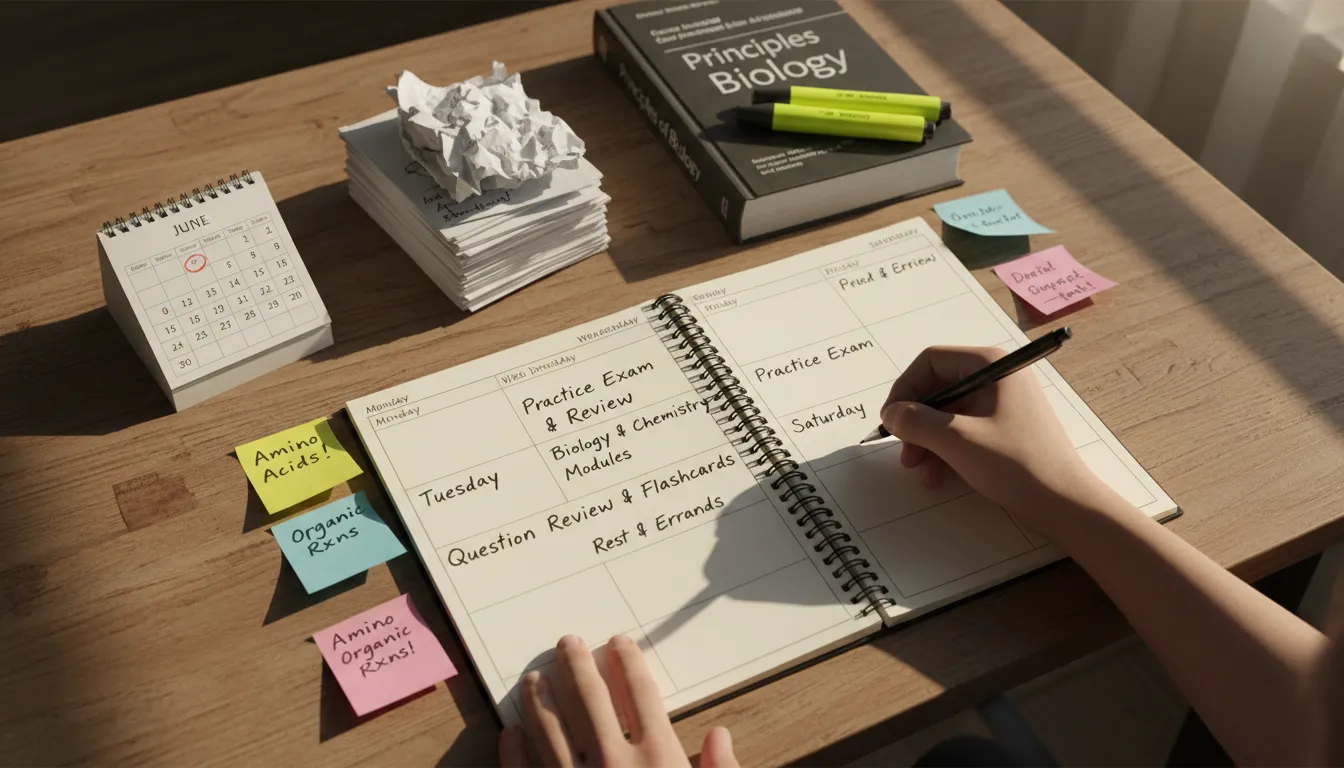
Finishing UWorld can feel less like a victory lap and more like a sudden gap in your MCAT plan. You have worked through thousands of questions, your subscription may be getting close to its end, and now you are asking what to do after finishing UWorld for the MCAT: redo incorrects, start AAMC material, take full-lengths, or keep reviewing Anki?
The answer is not to replace one giant resource with another. UWorld is most useful when it leaves you with data: the concepts you still cannot retrieve, the passages you misread, the timing habits that show up under pressure, and the questions you got right for the wrong reason. Your next phase should turn that data into a smaller, more focused plan.
| Your situation | Recommended next step |
|---|---|
| Your MCAT is approaching | Prioritize official AAMC materials, full-length review, and only the most relevant repairs. |
| You see repeated content weaknesses | Do targeted concept review, active recall, and fresh questions on that narrow skill. |
| You have many UWorld incorrects | Review recurring patterns instead of automatically resetting the entire QBank. |
| Your content is solid but timing is not | Use timed blocks, pacing notes, and one specific process checkpoint. |
| You are already taking full-lengths | Let recurring patterns from each exam choose your next review cycle. |

Why finishing UWorld does not automatically mean you are ready
Completion tells you that you saw the questions. It does not tell you whether you repaired the reasons you missed them. A student can finish every question and still repeatedly confuse a physiology relationship, rush graph interpretation, or choose CARS answers that sound plausible but are not supported by the passage.
What matters more is whether the same error type keeps appearing in new forms. If you used an explanation to identify a rule, then later retrieved and applied it, the question did its job.
Include uncertain correct answers in that review. A lucky guess, an answer changed without evidence, or a question you cannot explain cleanly may be a future miss even though it did not hurt your score today.
Should you redo all UWorld incorrects for the MCAT?
Usually, no. Resetting every incorrect can feel productive, but it can also turn into answer recognition. You remember the old passage, remember the visual layout, and choose correctly without proving that you can handle the same concept on a new question.
Redo targeted UWorld incorrects when they reveal:
- A repeated content gap, such as an equation, pathway, or relationship you still cannot explain.
- A concept you recognize in a review screen but cannot retrieve under time pressure.
- A recurring reasoning pattern, such as ignoring a graph condition or assuming correlation proves causation.
Do not redo an item simply because it was once wrong. First write the transferable rule, then revisit it after the explanation is less familiar. If the same error returns on fresh material, it may be a test-taking process rather than a lack of exposure.
For a fuller question-by-question method, use LoopdMed’s guide on how to review MCAT practice questions. The goal is to turn an incorrect into a decision you can make differently, not to build an archive of old answers.
How do you separate UWorld content gaps from test-taking mistakes?
Before scheduling more content review, ask what happened before you saw the explanation. Did you not know the concept? Did you know the concept but miss the word “except”? Did you identify the right equation but apply it to the wrong condition? Did you rush because of the clock?
Those are different problems and need different repairs. LoopdMed’s Error Taxonomy helps separate a true knowledge gap from recognition without retrieval, a stem-reading error, a logic flaw, timing pressure, or a CARS evidence mismatch.
Use a short repair map:
- Content gap: Learn the narrow concept, then create one retrieval prompt.
- Recognition without retrieval: Turn the rule into a question and bring it back after a delay.
- Stem-reading error: Record the qualifier or task you missed and use a final-line checkpoint in the next block.
- Logic flaw: Write the unsupported assumption and the evidence-based inference you should have made.
- Timing error: Track the specific shortcut, such as skipping units or failing to identify graph axes.
- CARS evidence mismatch: Find the sentence, contrast, or author move that should have controlled your choice.
This is where a Missed Question Log becomes more useful than a folder of screenshots. It keeps the reason for the miss and next action together without reproducing licensed material.
The distinction also reflects the exam itself. The AAMC’s sample-question guide describes science questions as applying foundational knowledge and using scientific reasoning, while CARS asks you to comprehend, analyze, evaluate, and draw inferences from text. A correct repair should match the skill that failed.
When should you start AAMC materials after UWorld?
Do not let UWorld completion set the date by itself. The better question is whether you have enough time to use official material, review it carefully, and act on what it reveals. Starting too early can waste limited material; waiting too long can crowd out review.
Use three signals to make the transition:
Your test date and remaining official material
Map the remaining weeks against the official question packs, section-focused materials, and full-lengths you intend to use. Build in review time: a full-length creates wrong answers, lucky guesses, and uncertain correct answers that need attention.
The AAMC’s official prep catalog currently includes full-length practice exams with answer-choice explanations, plus targeted question sets across the tested subjects. Treat those explanations as feedback, not as something to skim before opening the next resource. AAMC Official Prep
Your full-length schedule
Schedule full lengths with enough room to review the exam and complete its repair tasks. Back-to-back exams may give you more scores, but they can hide why the same errors return.
Your current pattern, not your anxiety
You do not need to finish UWorld perfectly before using AAMC materials. You do need a plan for the issues UWorld already surfaced. If a handful of topics or error types are repeating, carry them into the official-material phase as a focused review queue instead of starting from zero.
Build a weekly post-UWorld MCAT study plan
The weeks after UWorld should feel narrower, not emptier. You are no longer trying to see everything for the first time. You are practicing, diagnosing, and revisiting the few lessons most likely to matter again.
An illustrative weekly workflow might look like this:
- Practice: Complete a targeted question block or scheduled full-length.
- Review: Re-answer priority questions if possible, then read the explanation and tag the primary reason each wrong, guessed, or uncertain answer happened.
- Repair: Extract one transferable rule and choose the smallest next action: concept review, retrieval prompt, reading checkpoint, pacing drill, or passage-evidence practice.
- Recall: Review the rules already in your queue before adding a large batch of new material.
- Plan: At the end of the week, look for repeated tags and select one or two patterns for the next week.
Here is an example seven-day schedule. It is a template, not a universal prescription; adjust the workload around your test date, school schedule, and recovery needs.
| Day | Focus |
|---|---|
| Day 1 | Take a full-length or a targeted timed block. |
| Day 2 | Review wrong answers, lucky guesses, and uncertain correct answers. |
| Day 3 | Complete focused content repair and active recall for the highest-priority misses. |
| Day 4 | Do a timed targeted block that tests one repair area. |
| Day 5 | Review the block, then revisit older rules in your queue. |
| Day 6 | Practice CARS or another weak skill, followed by a short pattern review. |
| Day 7 | Light spaced recall, plan the next week, and protect recovery time. |
Keep Anki or another flashcard system for small facts, mechanisms, and relationships. A missed qualifier or rushed graph read is better handled as a process rule you deliberately practice during a new block.
Research in health-professions education supports this emphasis on recall over familiar review. A systematic review of retrieval and distributed practice found significant benefits for one or both strategies in 43 of 63 included experiments. That does not prescribe one MCAT calendar, but it supports bringing a rule back after a delay instead of trusting that an explanation felt clear once.
A separate systematic review of test-enhanced learning similarly describes benefits for learning, retention, and transfer when learners attempt recall. For MCAT prep, that means testing the rule on a fresh question instead of only rereading the original rationale.
A post-UWorld MCAT scenario: two errors, two repairs
Imagine Maya finishes UWorld and sees two patterns in her review. She repeatedly misses electrochemistry questions because she cannot reliably connect cell potential, spontaneity, and the sign of delta G. She also gets some CARS questions wrong even when she understands the passage because her choices reach beyond what the author actually supports.
Maya should not reset all of UWorld. For electrochemistry, she does a short concept repair, makes a recall prompt that links the relationships, and completes a fresh targeted set after a delay. For CARS, she logs the evidence mismatch, practices locating support before selecting an answer, and checks whether that tag appears in the next passages.
The two mistakes may have appeared in the same study week, but they need different repairs. That is what makes the post-UWorld phase more focused: the next task follows the error, not the resource you happen to own.

How should you use full-lengths after UWorld?
Use full lengths to find patterns, not just to predict a score. They show you what changes when stamina, pacing, and multiple sections interact. A full length may reveal that your content is stable early in the day but your graph interpretation falls apart late in Chem/Phys, or that CARS errors cluster when you start choosing answers before locating support.
After each exam, triage questions into four groups: wrong answers, lucky guesses, uncertain correct answers, and confident correct answers. Review the first three closely. For each one, record the earliest useful cause and one rule that could transfer to a new question. Confident correct answers usually do not need logging unless they reveal a pattern you are already tracking.
Then zoom out. One obscure question does not need to become next week’s entire plan. Three repeated timing errors or several misses tied to the same relationship do. LoopdMed’s MCAT workflow helps connect that question-level review to the study tasks you choose next.
How do you avoid forgetting MCAT content after UWorld?
Avoid the urge to reread every content book. Instead, protect the smaller set of rules that your practice says are unstable. Use a flashcard, short written prompt, or teach-back task to retrieve the rule without the original question in front of you.
Spaced review is useful here because it brings back a lesson after familiarity has faded. LoopdMed’s FSRS Spaced Repetition can keep rules and concepts in a focused review queue, while your new question blocks show whether the repair transfers.
The goal is not to remember every UWorld explanation. It is to remember the principle, passage habit, or decision rule that changes your response on the next question.
Finishing UWorld is the start of a more focused phase
You do not need to panic-reset every incorrect or immediately replace UWorld with five new resources. First, identify the patterns that remain: content you cannot retrieve, reasoning shortcuts, timing habits, and uncertain answers that never became stable.
Then let those patterns decide the next week. Your UWorld incorrects are not just a record of what went wrong. They are the data for your post-UWorld MCAT study plan. Build your focused review queue in LoopdMed and make the rest of your prep respond to what you actually need.