

You scored a 505 on your last MCAT practice test. Two weeks later, you scored a 506. After another week of studying, you are back at 505. You have completed hundreds of questions, reviewed your flashcards, and spent hours studying. So why is your score not moving?
An MCAT score plateau does not automatically mean you need to start over. It usually means your current study loop is not identifying the specific reasons points keep leaving the table. More work can repeat the same pattern when the repair is too broad, the review stays passive, or the real problem is timing or reasoning rather than missing content.
Here is the short answer: treat a meaningful MCAT score plateau as a narrow range across two or three comparable, realistically timed practice exams, not one disappointing full-length. Then compare the misses underneath the totals, choose one or two repeated problems, and test a focused repair on fresh material.
What counts as a real MCAT score plateau?
One lower practice score can reflect a harder set of topics, disrupted sleep, weak test conditions, or normal section-to-section variation. It is information, but it is not enough evidence to rebuild your whole plan. The companion guide on what to do after a bad MCAT full-length score is built for that first reaction.
A plateau becomes more meaningful when multiple practice exams are reasonably comparable: they were completed under realistic timing, you reviewed each one, and the total or section scores remain within a narrow band. The exact number does not matter as much as the repeated pattern. A stable total can also hide a changing problem, such as an improved Biology/Biochemistry section offset by new timing losses in Chem/Phys.
Using two or three exams is a practical diagnostic heuristic, not an official AAMC definition or a validated score threshold. Use it to decide when to inspect patterns more closely, not to make a high-stakes decision from a fixed number of tests.
Before calling it a plateau, check the conditions:
- Were the exams taken under similar timing, breaks, and distraction levels?
- Did you review incorrect, guessed, slow, and uncertain-correct questions after each exam?
- Are the same error types showing up again, or are you seeing unrelated one-off topics?
- Is one section flat while another is changing enough to conceal progress in the total?
The AAMC recommends taking practice under test-day timing and completing a review of incorrect or flagged questions. AAMC’s MCAT study-plan guidance supports using each full-length as feedback, not just a score prediction.
Why doing more questions can keep you stuck
More questions are useful only when they create a different decision next time. If every miss becomes a screenshot, a long explanation you reread once, or a vague note to “study this topic,” the next block may test the same weakness without any targeted repair.
The same problem happens when students treat every wrong answer as a content gap. A missed except qualifier, an unsupported CARS inference, and a rushed physics calculation need different responses. Relearning a chapter may feel productive, but it will not fix a reading checkpoint you never use.
Randomly restarting content review can also hide the data you already have. If you truly cannot explain a recurring concept, focused content repair is appropriate. But if several misses come from the same logic flaw or timing behavior, your best next step may be a short drill that tests that behavior under fresh conditions.
The five MCAT mistake patterns that commonly cap scores
The point of an MCAT error log is not to label yourself. It is to choose a repair that matches the first meaningful failure.
| Repeated pattern | What the evidence looks like | Targeted repair | How to retest it |
|---|---|---|---|
| Content gaps | You cannot explain a concept, equation, or relationship before seeing the explanation | Review the narrow concept, then create a concise recall prompt | Answer a fresh discrete or passage question using the same relationship |
| Stem-reading mistakes | You miss qualifiers, units, task words, or a condition in the final line | Add a visible stem checkpoint before choosing | Mark and answer a timed set while checking for qualifiers and the actual task |
| Logic flaws | You know facts but make an unsupported inference from data or passage evidence | Write a rule for the missing inference and complete a targeted data-reasoning drill | Explain the reasoning on a new passage before looking at choices |
| Timing or stamina collapse | Accuracy or pace drops late in sections, or you rush after getting stuck | Identify the bottleneck and test one pacing behavior | Compare question timing and late-section accuracy on the next timed block |
| Shaky recall or CARS evidence errors | You recognize the explanation but cannot produce the rule, or choose an answer beyond passage support | Use active recall for the rule and an evidence checkpoint for the passage | Retrieve the rule later, then test it in a new CARS or science passage |
For a more detailed diagnosis of individual misses, use MCAT mistake analysis. A plateau article should not turn every question into a different project. It should show which category keeps returning often enough to deserve the next focused study block.
How to compare MCAT mistakes across full-lengths and blocks
Start with question-level review, then step back. After each full-length or several timed blocks, sort priority questions by the first useful error type: content, stem reading, logic, timing, or CARS evidence. Include guessed-right, slow-right, and uncertain-correct questions when they reveal an unreliable process.
Next, look for patterns in two directions. First, compare error cause: do missed qualifiers appear in multiple sections? Does a passage-logic flaw keep appearing even when the topic changes? Second, compare topic and timing: are content gaps clustering around one system, or does the final third of a section consistently become rushed?
This prevents a total score from flattening the useful detail. Three unfamiliar amino-acid questions may point to content repair. Three rushed calculations near the end of Chem/Phys point to a pacing experiment. Both can happen in the same exam, but they should not receive the same intervention.
Example: turn a score report into a pattern analysis
| Question | Error type | Repeated issue | Next action |
|---|---|---|---|
| C/P #12 | Timing | Spending too long on calculations | Practice a short timed calculation set and record where pace slows |
| C/P #28 | Timing | Rereading the stem after getting stuck | Use a decision checkpoint before restarting the calculation |
| CARS #17 | Evidence | Unsupported inference | Identify the author claim or passage support before choosing |
| B/B #31 | Content | Enzyme-kinetics relationship is not retrievable | Review the narrow concept, make one recall prompt, and test it on fresh practice |
The first two rows suggest one Chem/Phys pacing pattern, so they should be tested together rather than treated as unrelated misses. The CARS and Biology/Biochemistry rows need separate, smaller repairs. This is what makes an error log useful: it turns a flat score into a short list of decisions about what to change next.
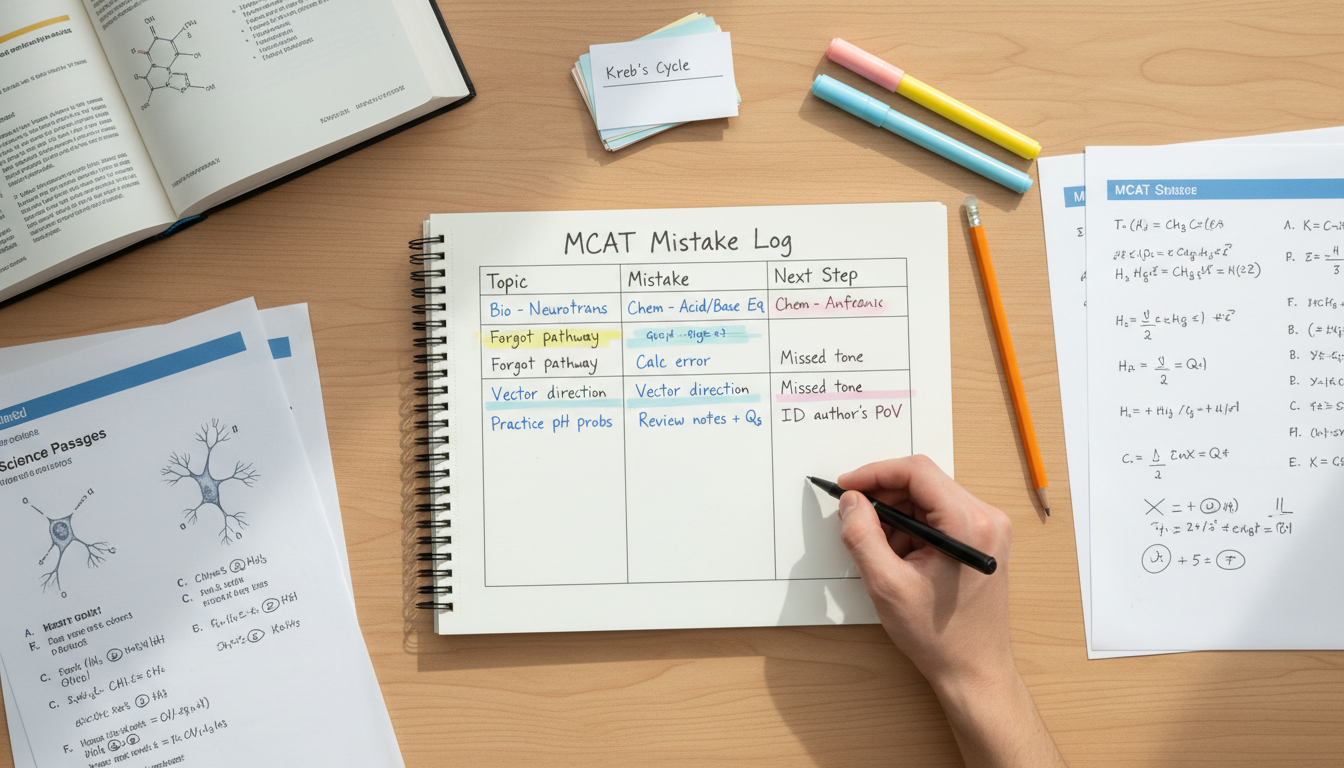
LoopdMed’s Missed Question Log keeps each source, error reason, rule, and next action together. Its Error Taxonomy makes recurring causes easier to compare across topics and practice dates.
What should you change when your MCAT score is not improving?
Change the smallest thing that addresses the repeated pattern. Broad changes feel decisive, but they make it hard to tell what actually improved.
For recurring content gaps, repair the narrow relationship and test it with active recall before fresh practice. For logic flaws, write the inference you skipped and practice the reasoning on new data. For timing, test one behavior such as setting a checkpoint after a fixed number of questions or moving on after a planned decision point. For CARS evidence issues, require yourself to identify the passage support before committing to an answer.
Do not change content review, question volume, timing strategy, and resource stack all in the same week. A plateau diagnosis works when you can see whether one selected repair changed the same pattern. FSRS spaced repetition can bring back facts and rules after the original explanation fades, while new practice checks whether the repair transfers.
A two-week MCAT plateau diagnosis plan
Use this as an illustrative reset, not a universal calendar. Adjust the volume to your available time and upcoming test date.
Week 1: Find the repeat pattern
- Gather two or three comparable practice exams or a set of timed blocks.
- Review wrong, guessed, slow, and uncertain questions using a consistent error label.
- Count the repeated causes and note section-level timing or accuracy drops.
- Choose one primary pattern and, at most, one secondary pattern to repair next week.
- Write one measurable target for each. For example: “Identify the data trend before selecting a science mechanism” or “Check the final task word before eliminating choices.”
Week 2: Repair, retrieve, and retest
- Complete focused content review only for documented knowledge gaps.
- Turn the essential rules into short active-recall prompts.
- Practice the chosen reasoning, reading, or pacing behavior in fresh timed sets.
- Review the new set with the same tags and compare whether the selected pattern recurred.
- Keep, refine, or replace the intervention only after you have new evidence.
This approach avoids the trap of studying harder without knowing what changed. It also keeps a difficult week from becoming a verdict on your readiness.

A score plateau example: stable total, two different problems
Imagine that Priya takes three realistic full-lengths and stays in a similar total-score range. The total looks flat, but her review shows two specific patterns. In Chem/Phys, she understands most equations after the fact, yet loses time rereading calculations and rushes the final questions. In CARS, she often picks an answer that sounds plausible but cannot point to language that supports it.
Priya does not restart every science chapter or add hundreds of new cards. For Chem/Phys, she reviews the recurring calculation bottleneck, uses one planned pacing checkpoint, and tests it in two new timed science blocks. For CARS, she logs the evidence mismatch and practices naming the author claim or supporting line before choosing.
After the next round of practice, Priya compares the same measures: late-section pace, calculation-related errors, and CARS evidence tags. Her total score may not jump immediately, but she now has evidence about whether the selected problems are becoming less frequent. That is more useful than guessing which resource to replace.
Build a mistake-driven review queue instead of starting over
An MCAT score plateau is often a pattern problem. The way out is not to treat every old mistake as equally important or every new resource as a solution. Keep the questions that expose a repeatable weakness, name the cause, preserve one transferable rule, and schedule the right kind of repair.
Research in health-professions education supports retrieval and distributed practice as learning principles, although the interventions and outcomes vary. This systematic review found benefits for retrieval practice and/or distributed practice in 43 of 63 included experiments. It does not prove one exact MCAT plan or guarantee a score change; it supports returning to the lessons worth retrieving instead of relying on one-time rereading.